


A large product catalog is one of the hardest categories to get right in SEO. The volume of pages is an asset — thousands of potential entry points from organic search. But without a coherent structure, that volume becomes a liability: near-duplicate content, diluted authority, and thin pages that Google ignores regardless of how competitive the keywords are.
This client was a national retailer of industrial manufacturer parts — thousands of SKUs across dozens of categories. The site had some traffic, but almost none came from organic search. When we audited it, the reason was immediate: the catalog had been built for internal convenience, not for search engines or buyers. Category pages were shallow. Product URLs were auto-generated without hierarchy. Metadata was either missing or templated boilerplate that gave Google nothing to differentiate one page from the next.
The Audit Before the Redesign
We ran a full UX/UI audit before touching a single meta tag. That sounds counterintuitive for an SEO engagement, but it matters: catalog redesigns that don't account for actual user navigation patterns produce a structure that ranks and converts poorly in equal measure. The audit identified which categories buyers actually navigated through, where they abandoned, and which filters they relied on — information that shaped the new architecture directly.
The technical audit ran in parallel. What we found: redirect chains across old category URLs, a flat URL structure that gave crawlers no sense of hierarchy, canonical tags either missing or pointing to the wrong variants, and a sitemap that included thousands of near-duplicate filter pages Google had already decided weren't worth indexing. On top of that, the site had accumulated multiple domain mirrors over years of development — each carrying partial authority rather than concentrating it in one canonical source.
A site can't rank if crawlers can't parse it. That was the starting point.
Rebuilding the Catalog With SEO as a First Principle
The redesign addressed both problems simultaneously. On the structural side, we rebuilt the category hierarchy to match how buyers actually think about parts — by application, then by specification, then by individual product. That's not how the original catalog was organized. It used the supplier's internal classification, which meant subcategories that made sense to the procurement team but had no relationship to how buyers phrase searches.
On the technical side, we implemented a URL structure that reflected the new hierarchy, cleaned up the canonical strategy, pruned the sitemap down to pages worth indexing, and resolved the redirect chains. Mirror consolidation was part of this — merging all domain variants into a single canonical source so that every backlink and every crawl signal pointed the same direction. None of this is visible to users. It's also the work most catalog projects skip, which is exactly why most catalog sites have traffic ceilings they can't explain.
Listing Pages and Product Cards: The Content Layer
Once the structure was stable, we moved to the content layer: meta titles, meta descriptions, and attribute content across the catalog. At this scale, the lazy version is to write one template and auto-generate everything from product data: “[Product Name] — Buy at [Store].” That fills the field. It doesn't attract clicks or give Google context.
We developed templates for each category tier informed by the actual search queries we'd mapped — what buyers search for at the top-of-category level versus specific part searches. Category-level meta descriptions answered the category question; product-level descriptions addressed the part-level purchase decision. Where product attributes existed in the database — material specs, compatibility notes, tolerances, thread types — we structured that content into the page itself rather than leaving it buried in a raw data table.
The listing pages got additional treatment. A listing page for a product category that shows only a grid of cards is thin by default — it has no content for Google to evaluate beyond the category name. We added factual introductory content for each major category: what distinguishes the products, what specs buyers should check, what the common use cases are. Short, specific, and accurate — not padding for its own sake. That content gave the listing pages something to rank for beyond just the category keyword.
What the Numbers Showed
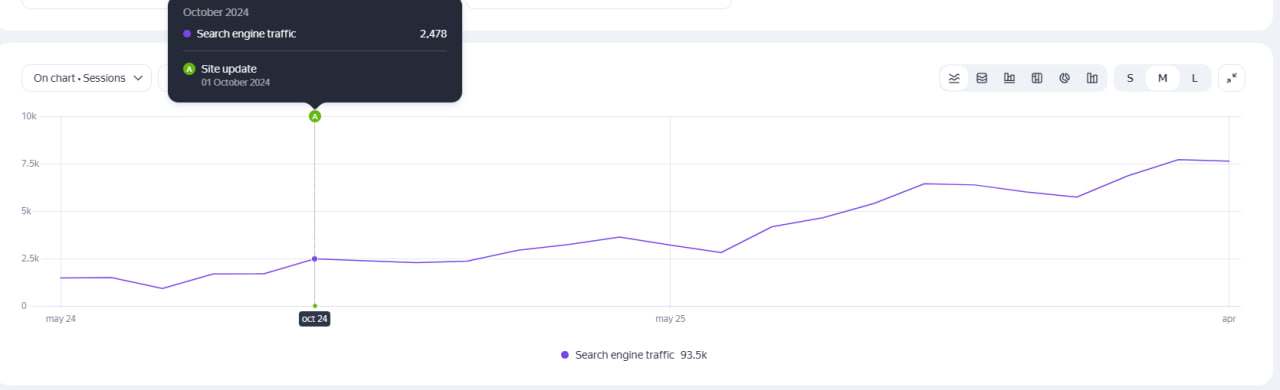
The site update went live on October 1, 2024. In that first month, search engine sessions reached 2,478 — already showing movement from the structural fixes, which crawlers pick up quickly once redirects and canonicals are resolved. By March 2025, monthly organic sessions had reached 7,500. Total search engine traffic over the full tracked period came to 93,500 sessions.
That's roughly 3× growth from the update baseline — and it was a curve, not a spike. Spikes come from campaigns or one-off traffic events and disappear. A curve means pages are ranking better, rankings are holding, and new pages are entering the index cleanly. The growth was durable because it was structural.
The pattern that stood out in the data: the main driver wasn't branded search or the homepage. It was the category listing pages and product cards — the exact pages where we'd invested the structural and content work. Those pages accounted for the majority of new organic sessions. When a listing page has a clear URL, a relevant title, and introductory content that matches search intent, Google can finally evaluate what it's for. That evaluation is what ranking depends on.
Why the Sequence Matters
The conventional catalog SEO project starts with content — write product descriptions, add meta tags, publish category copy — and fixes structure later or not at all. That sequence fails because content on a technically broken site doesn't land. A site where crawlers can't determine the relationship between a category page and its subcategories can't pass authority efficiently, regardless of how many words are on each page.
The right order is: audit first, fix the foundation, then build content on top of it. For a catalog of any real size, the foundation work — URL hierarchy, canonicals, redirects, sitemap hygiene, mirror consolidation — is several weeks of work before a single meta description is written. It's also the investment that compounds: every new page added after the structure is correct benefits from the site authority that's been properly consolidated, rather than fragmenting it further.
If your catalog is generating impressions in Search Console but low clicks, or ranking for some terms but hitting a ceiling you can't push past, the issue is usually structural — not a content volume problem. Take a look at our SEO services. We do catalog audits and rebuild the architecture before touching any copy.
Get in touch